Giorgio de Chirico
( Italian, 1888-1978 )
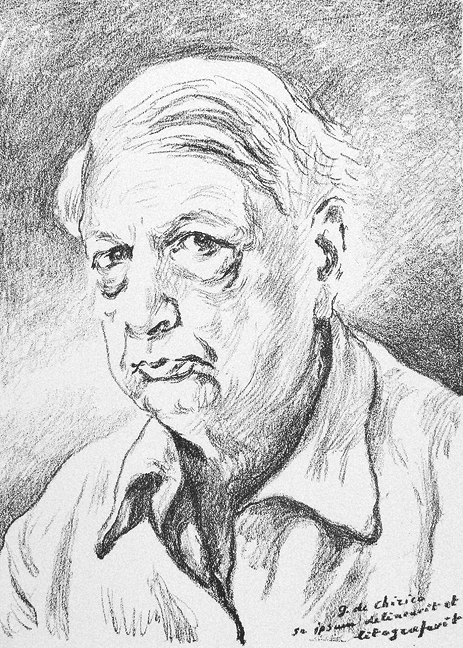

Currently featuring 5 works, please scroll down.


Manichino, 1964

( Mannequin )
Inventory #51947

Original color lithograph with full margins. Hand signed and numbered in pencil, "G. de Chirico" lower center, and "55/120" lower left. Also signed in the stone, "G. de Chirico" lower right. Impression from the signed and numbered edition of 120, aside form a few artist's proofs. Printed by Bulla di Roma. Published by Rotografica in 1964.

Sheet size: 16 5/16" x 11 3/8"
Catalogue reference: Ciranna 129

Giorgio de Chirico was born in 1888 in Corfu, Greece to the family of an Italian railroad engineer. As a young man, de Chirico studied in Munich where he was greatly influenced by the philosophical writings of Nietzsche and Schopenhauer, and the Symbolist art of Arnold Böcklin. In 1910, de Chirico moved to Paris where he spent a considerable portion of his career. There he made contact with the Spanish artist, Pablo Picasso and befriended the French poet, Guillaume Apollinaire.

Around 1917, de Chirico developed his concept of Pittura Metafisica (Metaphysical painting) and began producing disturbing, dreamlike images of deserted cities and still scenes with mysterious mannequins made from combinations of objects. These pictures of a restless dream world evoke the heightened perception of the subconscious and are the direct antecedents of the Surrealism of the 1920s.

De Chirico's Metaphysical paintings were hugely influential on the Surrealist artists, including Salvador Dalí, René Magritte, and Max Ernst. The Surrealists recognized in his paintings the eloquent expression of the unconscious and nonsensical to which they themselves aspired. In 1926, however de Chirico changed to a more classical style with traditional subject matter, which lead to his break with the Surrealist group and André Breton calling him "a lost genius." It was not until 1955-1960 that de Chirico openly went back to creating art with Metaphysical subject matter.


Calligrammes 157, 1930

Inventory #IE104

Original lithograph printed in black ink on Whatman wove paper with watermark, and blindstamp of Galleria Ciranna, Milan, lower left. With full margins and deckled edges. Signed in pencil, lower right: "G. de Chirico". An impression from the total edition of 131 numbered on the colophon page. Printed in "Calligrammes" by Guillaume Apollinaire. Published by Gallimard, Paris, 1930.

Sheet size: 13" x 9 1/2"

Calligrammes, written by Guillaume Apollinaire and illustrated by Giorgio de Chirico, was published by Gallimard in Paris in 1930. The illustrations consisted of 66 lithographs, one of which was printed twice, for the cover and the title page. Each lithograph was designed directly on the stone by the artist and printed by Desjobert; the text was printed by M. Darantiére. Each lithograph in this particular edition is signed and has the circular blindstamp of "Galleria Ciranna Milano" in the lower left corner.

Giorgio de Chirico was born in Greece to a Genovese mother and a Sicilian father. The style for which he is most well known is called “Metaphysical painting” which is characterized in this lithograph by the barren landscape, distorted perspectives, tall archways, classical architecture, and Greek sculpture creating a lonely and mysterious space outside the realm of time. De Chirico's Metaphysical paintings were hugely influential for Dada and Surrealist artists throughout Europe, including Salvador Dali, Max Ernst, and René Magritte. The Surrealists recognized in de Chirico’s paintings “the eloquent expression of the unconscious and nonsensical to which they themselves aspired.”

In 1926, de Chirico adopted a more realistic style that featured more conventional subjects causing a break with the Surrealist group and leading André Breton to call him "a lost genius." After a long hiatus from his signature style, de Chirico openly returned to painting Metaphysical subjects around 1955.


From “The Apocalypse”: Una donna ravvolta nel sole, 1941
(A woman enveloped in the sun )
Inventory # 51026

Original lithograph on simulated Japon paper. Hand signed by the artist "G. de Chirico" in pencil, lower right. One of twenty lithographs from the portfolio "Apocalisse." Impression from the portfolio numbered "12/150", aside from 10 for trade numbered "i – x", all on simulated Japon paper and each comprised a double series of lithographs.

Sheet size: 13 3/4" x 10 4/5"
Catalogue reference: Ciranna 104

The edition of the Apocalypse illustrated by de Chirico was published in 1941 in Milan under the supervision of Raffaele Carrieri, in the translation of Monsignor Antonio Martini and with an introduction by M. Bontempelli.


From “The Apocalypse”: Aveva una bilancia nella sua mano, 1941
( Had a seal in her hand )
Inventory # 51027

Original lithograph on simulated Japon paper. Hand signed by the artist "G. de Chirico" in pencil, lower right. One of twenty lithographs from the portfolio "Apocalisse." Impression from the portfolio numbered "12/150", aside from 10 for trade numbered "i – x", all on simulated Japon paper and each comprised a double series of lithographs, in part colored by hand underneath the direction of the artist.

Sheet size: 13 3/4" x 10 4/5"
Catalogue reference: Ciranna 99


From “The Apocalypse”: Sette angeli provvisti di sette piaghe, 1941
( Seven angels with seven wounds )
Inventory # 51028

Original lithograph on simulated Japon paper. Hand signed by the artist "G. de Chirico" in pencil, lower right. One of twenty lithographs from the portfolio "Apocalisse." Impression from the portfolio numbered "12/150", aside from 10 for trade numbered "i – x", all on simulated Japon paper and each comprised a double series of lithographs, in part colored by hand under the direction of the artist.

Sheet size: 13 3/4" x 10 4/5"
Catalogue reference: Ciranna 101


GALLERY

ARTISTS
Please call (415) 433-2771 or e-mail
while these rare works are available.