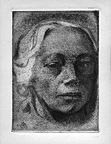
- Käthe
Kollwitz
Käthe Schmidt Kollwitz was born into a socially conscious family in Koenigsberg, East Prussia, on July 8,1867. She was influenced by her father's socialist beliefs and by her grandfather who believed so strongly in the separation of church and state that he founded the first Free Religious Congregation in Germany. Given her progressive background it is not surprising that Kollwitz dedicated her career to working in the most populist of all mediums. Printmaking allowed Kollwitz to make her art available to the public including members of the impoverished working class. She often contributed images to propaganda posters advocating for social equality. In her prolific career she produced over 270 etchings, woodcuts and lithographs dedicated to portraying social messages against the suffering caused by war and the exploitation of the proletariat.
A major influence on Kollwitz style was the naturalism and social commentary found in the work of Max Klinger. In Klinger's famous essay "Painting and Drawing," he states that "Printmaking and drawing are two techniques which are truly able to express the inner emotions of pain, sorrow and loneliness." The graphic work done by Kollwitz is a testament to Klinger's statement; indeed, few artists of the twentieth century have created a more powerful emotional language.
Kollwitz' best known graphic works are her cycles of etchings, woodcuts and lithographs. In 1893, Kollwitz produced her first cycle, "Die Weberaufstand" ( The Weavers' Revolt ). The series of six etchings was based on the uprisings of the Silesian weavers in 1844. Following the success and acclaim of her first cycle, Kollwitz followed with a similar historic theme.
The second major cycle from 1902-1908 is called "Bauernkrieg" ( Peasants' War ). This series of seven etchings was based on the 1524-1525 peasant uprisings in southern and central Germany. Kollwitz depicts the peasants rallying to fight their oppressors for more equitable living conditions and the documents the tragic effects of their defeat. "Black Anna," the heroine portrayed in Plate 3 "Beim Denglen" ( Sharpening the Scythe ), exemplifies the tender yet courageous character of many of Kollwitz's female protagonists.
The third cycle, 1922-1923, entitled "Krieg" ( War ) consisted of seven woodcuts. This cycle was inspired by the senseless pain, suffering and grief felt throughout Europe during the First World War. Unlike the previous cycles, the "Krieg" cycle was very personal for Kollwitz. She was deeply affected by the loss of her son Peter who was killed on the Flanders battlefield in 1914. The stark characteristics of the woodcut medium emphasize the intensity of her message.
Kollwitz' fourth and final cycle, "Tod" ( Death ) consisted of eight lithographs executed between 1934-1935. At this time, Kollwitz was facing her own mortality and the inevitable rise of the dictatorial Nazi regime. These lithographs represent eight conversations with a personified figure of death. In the mid-1930s Hitler's regime blacklisted Kollwitz and some of her contemporaries claiming their art was degenerate and unsuitable for public view. The Nazi authorities forced her to resign from her post as a professor at the Prussian Academy of Arts. Refusing to submit to the Nazis' demands for propaganda, they excluded her from all official public exhibitions.
In the faces and bodies of Kollwitz' protagonists the wrongs of her time are reflected and there is a direct appeal for change. Kollwitz' graphic works exemplify the power of art to transform society. They stand as a timeless reminder of the constant human struggle for peace and against oppression. Kollwitz remained in Germany until her death in April of 1945 just days before the end of World War II.
With our nation currently at war, Kollwitz lifelong impassioned plea as a woman, wife, mother and artist against war remains as relevant and inspirational today as it was in her time.