- Marino
Marini
- ( Italian, 1901 - 1981 )
- ( Italian, 1901 - 1981 )
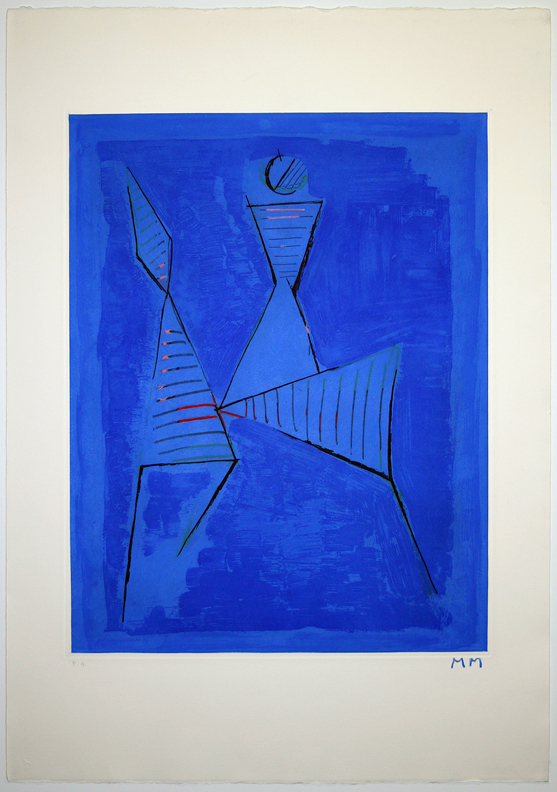
Marino from Goethe, 1979
Inventory # 51768
|
Original etching and colored aquatint on Arches wove paper. Hand signed by the artist "MM" in blue pencil, lower right and annotated "P.A." (Prova d'artista) in pencil, lower left. This impression is one of 20 artist proofs, aside from an edition of 125 numbered in Arabic numerals, and an edition of 50 numbered in Roman numerals. One of four plates from the series, "Marino from Goethe." Printed by Labyrinth, Florence. Published by ZWR, London, 1980. With the Publisher's blindstamp, lower left. In excellent condition, framed with museum quality conservation materials. Platemark: 24 7/8" x 19 1/4"; Sheet size: 35 3/4" x 24 1/2"; Framed: 42 1/16" 35 5/16" Marino's first etching was executed in 1917 when he began classes at the Regio Istituto di Belle Arti in Florence. However his first stone lithograph was not executed until much later, in 1943. Between the years 1975 until his death in 1980 Marino worked almost exclusively on etchings and lithographs. His graphic production during these last five years was indeed prolific including close to 50 etchings/aquatints and 15 lithographs. The themes of the horse and rider, the juggler, and the Pomona are repeated throughout his graphic works, always in a state of suspense and transition. Marino uses vivid colors to convey perspective, form, space and mood. Ultimately Marino's graphic works focus on the representation of a personal mythical canon, using timeless archetypal characters to display a continuing human truth. |
|
|

|
|
while thise fine work is available.